Floating Dock Anchor Pole with T-Handle
If you're installing a floating dock and want to keep it removable for seasonal exemption purposes, a spud-pole style anchor is the standard approach discussed throughout this guide. This 7.75-foot anchor pole anchors the dock to the lakebed without permanent pilings, and lifts out by hand each fall — no excavation, no embedded hardware, no permit complications.
View on Amazon →One of the most common assumptions dock owners make is that a floating dock — because it doesn't permanently attach to the lake bottom — automatically requires no permit. In some states and situations, that's correct. In others, it's completely wrong. Understanding exactly where the line falls in your state can save you from a surprise enforcement action.
Why Dock Type Matters to Regulators
State agencies regulate docks primarily to protect water quality, navigation, aquatic habitat, and public access to water resources. From a regulatory standpoint, the key distinctions aren't always "floating vs. fixed" — they're more nuanced:
- Permanent vs. seasonal: Does the dock remain in the water year-round, or is it removed seasonally?
- Embedded vs. non-embedded: Does construction involve driving pilings or placing cribs into the water bottom?
- Footprint size: How much lake surface area does the structure cover?
- Anchoring method: Are anchors or spuds used (common for floating docks) versus permanent embedded pilings?
Many state exemptions are written around these factors rather than explicitly around "floating" vs. "fixed" terminology. A floating dock anchored with spuds that is removed seasonally looks very different to a regulator than a floating dock permanently chained to embedded concrete anchors year-round.
State-by-State: How Floating Docks Are Treated
Minnesota: Seasonal Removal Is Key
Minnesota's DNR no-permit threshold applies to docks regardless of construction type — the critical factors are the 8-foot width limit, no permanent embedded structure, and consistency with local rules. A floating dock that is 8 feet or less wide and removed seasonally typically needs no DNR permit. A floating dock that exceeds 8 feet in width needs at minimum to qualify under General Permit 2008-0401. See the full Minnesota guide.
Michigan: 6-Foot Seasonal Rule Applies to Both Types
Michigan's Part 301 exemption for inland lakes applies to docks — floating or fixed — that are 6 feet wide or less, removed seasonally before December 1, and don't involve permanent embedded pilings or fill. A floating dock meeting these criteria needs no EGLE permit. A permanent floating dock (left in water year-round, or anchored with embedded concrete) does not qualify for the exemption. See the full Michigan guide.
Florida: Floating Docks Count Toward the Square Footage Threshold
Florida's DEP exemption is based on total overwater square footage — and that calculation includes floating docks. A floating dock of 600 square feet on a standard (non-OFW) freshwater lake still counts against the 1,000-square-foot threshold. There is no floating-dock carve-out in Florida's system. See the full Florida guide.
Tennessee (TVA): Floating Docks Still Require Section 26a Permits
TVA's Section 26a requirement applies to all structures — floating or fixed — placed on TVA reservoirs. A floating dock requires the same Section 26a permit as a fixed pier. The type of dock affects design requirements and standards, but not whether a permit is needed. See the full Tennessee guide.
Wisconsin: Piers Generally Exempt If Seasonal and Size-Compliant
Wisconsin DNR generally does not require a permit for piers (including floating docks) on inland lakes if they are seasonal (removed in fall), do not disturb the lake bed beyond the footprint, and comply with local ordinances. Piers on designated navigable waterways and those involving dredging require permits. Local setback and size ordinances vary widely across Wisconsin's 72 counties.
The Army Corps and Floating Docks
The Army Corps of Engineers' jurisdiction applies based on the water body type, not the dock structure type. A floating dock on navigable federal waters requires the same Nationwide Permit review as a fixed dock. The Corps' primary concern is navigational safety and waterway obstruction — a floating dock can obstruct navigation just as readily as a fixed one. Nationwide Permit 4 and related NWPs apply equally to floating structures.
Floating Dock Anchoring: The Detail That Changes Everything
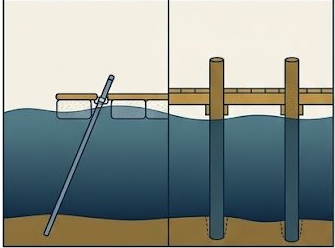
How a floating dock is anchored is often the deciding factor in whether a permit is required. There are three common anchoring methods, each with different regulatory implications:
1. Spud Poles / Pipe Anchors (Most Permit-Friendly)
Spud poles are vertical pipes or rods driven temporarily into the lake bottom to hold a floating dock in place. Because they are removable and don't involve permanent embedding, most state agencies treat spud-anchored docks as seasonal structures eligible for the lowest level of regulatory scrutiny. This is the most common anchoring method for "permit-exempt" floating docks.
2. Rope/Chain to Shore Anchors
Floating docks anchored with rope or chain to shore-based cleats or posts are typically treated similarly to spud anchors — as non-permanent. The key is whether the shore-side anchor involves embedded concrete or permanent construction (which could trigger separate permit requirements).
3. Embedded Concrete Anchors or Permanent Pilings
Floating docks anchored to embedded concrete blocks placed in the lake bottom, or to permanent pilings driven into the bottom, are treated by most state agencies as permanent structures regardless of whether the floating deck portion is removable. This anchoring method typically eliminates any seasonal-dock exemption and triggers the full permit process.
Key Questions to Ask Before Buying a Floating Dock
Before purchasing a floating dock system, confirm these points with your state agency and local government:
- Does your state distinguish between floating and fixed docks for permitting purposes?
- Is seasonal removal required for the no-permit exemption, and what is the removal deadline?
- Does the anchoring method (spud, chain, embedded) affect your permit status?
- Does your county or township have additional rules about floating docks?
- Is your water body subject to Army Corps jurisdiction?
Free Download: Dock Permit Application Prep Checklist
Includes a floating dock anchoring documentation section to help you confirm and record your dock's exemption eligibility.
Download Free PDF →